Beating the Bottleneck: How Regional Elevator Constraints Are Rewarding Farmers Who Harvest First
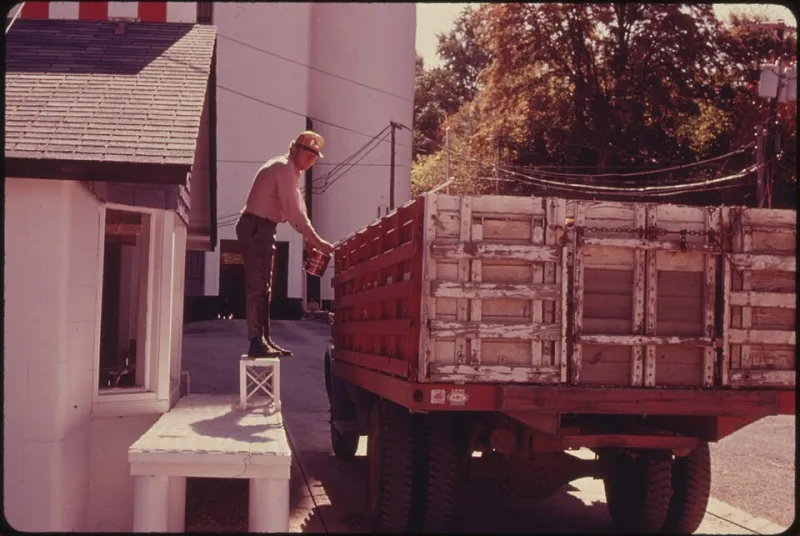
Photo: Patricia DuBose Duncan, Public domain, via Wikimedia Commons
For most of the growing season, farmers rightly focus on yield. But in the weeks immediately surrounding harvest, a separate and often underappreciated variable enters the equation: where, exactly, will the grain go? The answer to that question—shaped by regional elevator capacity, trucking logistics, and the sheer volume of competing supply hitting local markets simultaneously—can be worth as much as 30 to 60 cents per bushel to the farmer who plans accordingly.
National commodity prices set a floor. Basis sets the ceiling. And in years when harvest volumes strain regional infrastructure, basis movement becomes one of the most consequential price signals available to American row-crop producers.
The Structural Mismatch Between Volume and Capacity
U.S. corn and soybean production has expanded substantially over the past decade, driven by yield improvements, acreage shifts, and better agronomic practices. What has not kept pace, in many regions, is the physical infrastructure required to receive, dry, and store that grain. Commercial elevator capacity across the Corn Belt has grown, but not uniformly—and the gaps between production volumes and storage capacity are widest in precisely the areas that have seen the largest yield gains.
In western Iowa, parts of eastern Nebraska, and select districts across Indiana and Ohio, elevator operators have reported fill rates exceeding 85 percent during the first two weeks of corn harvest in recent years. At those levels, elevators begin imposing storage delays, restricting truck traffic windows, and—critically—widening basis to discourage additional inbound volume. That basis widening is not arbitrary. It is a direct market signal reflecting a physical constraint: there is more grain than the local system can efficiently absorb.
For the farmer who arrives at the elevator during peak congestion, that widened basis represents a direct reduction in realized price. For the farmer who delivers ten days earlier—or who has negotiated a forward contract with a preferred delivery slot—the same physical constraint works in reverse, allowing them to sell into a tighter basis environment before the system becomes overwhelmed.
Reading Elevator Fill Rates as a Forward Indicator
Most commercial elevators do not publish real-time fill data, but the information is accessible to producers who ask directly and build relationships with elevator managers before harvest begins. A simple conversation in late August or early September—asking what percentage of licensed capacity is already committed to forward contracts, how much on-farm storage the elevator anticipates competing with, and whether they are projecting any receiving restrictions—can yield actionable intelligence that no national report provides.
Elevators operating in regions with limited on-farm bin capacity tend to experience the most acute congestion. When farmers in a given county rely heavily on commercial storage, harvest timing becomes a collective action problem: everyone needs the elevator at the same time, and the elevator cannot serve everyone equally. The farmers who recognize this dynamic and move to deliver earlier—or who lock in preferred delivery windows through harvest contracts—effectively extract a timing premium from a system that penalizes late arrivals.
Basis tracking tools, available through several commodity data services, can help producers monitor local basis trends historically and identify which elevators have shown the widest harvest-period basis swings over the past three to five years. Locations that consistently weaken basis by 20 cents or more between early October and peak harvest volume are, in effect, advertising the opportunity cost of waiting.
The Carry Structure and the Storage Decision
Capacity constraints also interact with the futures carry structure in ways that affect storage decisions. In a normal carry market, futures prices for deferred delivery months exceed nearby prices, theoretically compensating farmers for the cost of holding grain. But when local elevator storage is scarce, commercial storage rates rise and storage availability itself becomes rationed. A farmer who cannot secure commercial storage—or who faces elevated rates because the elevator is near capacity—may find that the theoretical carry in the futures market is inaccessible in practice.
This is where on-farm storage becomes a strategic asset rather than simply a convenience. Producers with adequate on-farm bin capacity can deliver to the elevator during the early harvest window when basis is tightest, capture the favorable price, and then hold any remaining production on-farm to sell into the carry as the market allows. This approach effectively decouples the harvest decision from the marketing decision—a separation that most grain marketing advisors consider essential to capturing full market value.
For operations without on-farm storage, the calculus is different but the underlying logic holds. Prioritizing early delivery, negotiating harvest contracts that guarantee elevator access, and monitoring basis closely in the days before combines roll are all tactics that can mitigate the penalty of operating in a capacity-constrained region.
Regional Bottlenecks Worth Watching in 2025
Several regions merit particular attention this harvest season. Parts of the eastern Corn Belt—specifically western Ohio and central Indiana—have seen consistent basis pressure during peak harvest as elevator networks in those areas manage volume from both strong local production and grain moving in from neighboring regions. The Mississippi River corridor, while offering export basis opportunities, can also become congested when barge logistics tighten.
In the Northern Plains, elevator capacity relative to production has tightened as sunflower, corn, and soybean acreage has expanded into areas where commercial storage infrastructure was historically sized for smaller wheat-based rotations. Producers in these transitional zones should be especially attentive to local basis behavior and elevator manager communications ahead of fall harvest.
Timing Is a Marketable Asset
The broader takeaway for producers is that harvest timing is not purely an agronomic decision. It is also a marketing decision, and in years when regional infrastructure is strained, the value of delivering early—into a less congested market with tighter basis—can rival or exceed the value of modest yield improvements from additional field drying time.
Farmers who treat their local elevator network as a source of market intelligence, who track historical basis behavior by location, and who plan harvest logistics with the same rigor they apply to agronomic decisions are consistently better positioned to capture the timing premiums that capacity-constrained markets create. The grain is the same. The price does not have to be.