The Fence Line Fallacy: Why Your Neighbor's Playbook Is Costing You Yield and Margin
Farming communities run on shared knowledge. It has always been this way — conversations at the co-op, comparisons at the elevator, the informal exchange of what worked and what didn't over a particular growing season. That culture of peer learning has genuine value, and it has contributed meaningfully to the productivity gains American agriculture has achieved over generations.
But there is a version of peer learning that crosses from useful into harmful, and it happens when a management practice or input strategy is adopted wholesale from a neighboring operation without accounting for the variables that made it work there and may prevent it from working here. We call this the fence line fallacy: the assumption that proximity implies comparability.
What the Fence Row Doesn't Show You
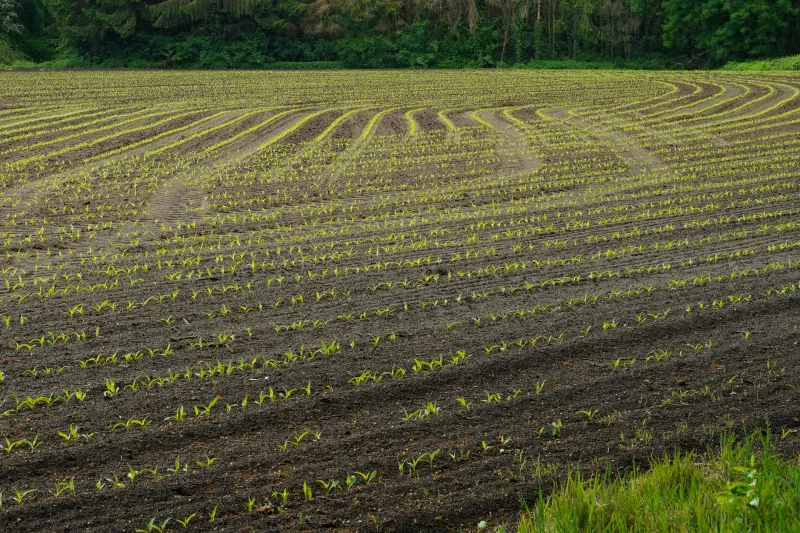
Consider two Iowa operations separated by a gravel road and a drainage ditch. Both plant the same corn hybrid, apply fertilizer at roughly similar rates, and use comparable equipment. One consistently yields 215 to 220 bushels per acre. The other plateaus around 190, despite the operator's best efforts to close the gap.
The obvious inference — that the higher-yielding neighbor has better management — may be partially true, but it is rarely the complete explanation. What the fence row doesn't show you is the subsurface drainage infrastructure that was tiled in the 1970s and expanded again in the early 2000s on one side of the road but not the other. It doesn't show you the twelve-inch organic matter gradient between the two fields' dominant soil series. It doesn't reveal the slight northwest-facing aspect that extends the lower field's frost exposure by an average of four to six days in spring, compressing the effective planting window in ways that compound across seasons.
These are not management variables. They are structural field characteristics that no amount of agronomic skill fully overcomes — and they make direct performance comparisons between adjacent operations fundamentally misleading.
The Hidden Architecture of Field Variability
Field-level variability operates across several dimensions that are often invisible to casual observation but highly consequential to yield outcomes.
Microclimate exposure is among the most underappreciated. In the rolling topography of the eastern Corn Belt, elevation differences of as little as fifteen to twenty feet can translate into meaningful differences in cold air pooling, frost timing, and solar radiation accumulation during critical early-season development windows. Two fields three miles apart may experience meaningfully different effective growing degree day accumulations in a given spring, despite being subject to the same regional weather forecast.
Soil biology is similarly invisible and similarly powerful. The microbial community structure within a field — shaped by decades of management history, tillage intensity, cover crop use, and organic matter inputs — influences nitrogen cycling, phosphorus availability, and disease suppression in ways that standard soil tests do not capture. A field that has been managed with consistent cover cropping and reduced tillage for fifteen years carries a biological asset that cannot be replicated simply by applying the fertility program that built it.
Drainage pattern and soil water dynamics determine how quickly a field recovers from excess moisture events and how deeply root systems can develop during dry periods. Tile drainage systems are not uniform in their coverage or condition, and even fields with comparable tile density can behave very differently depending on outlet capacity, lateral spacing, and the hydraulic conductivity of their underlying subsoil.
Equipment efficiency introduces another layer of variability that is rarely discussed when farmers compare notes. A planter operating at peak singulation accuracy on flat, well-prepared ground delivers a fundamentally different stand than the same planter pushed through variable residue conditions or across fields with significant terrain transitions. The yield gap that appears to reflect hybrid selection may actually reflect planting execution.
Why Regional Benchmarks Mislead
The same logic that undermines field-to-field comparisons applies with even greater force to regional and national yield benchmarks. When the USDA reports an Iowa corn yield of 202 bushels per acre, that number is a weighted average across an enormous diversity of soil types, drainage conditions, microclimate zones, and management histories. It tells a producer in Grundy County almost nothing useful about what their specific fields should be producing — or what the realistic ceiling for improvement might be.
Benchmarking against regional averages has a particular danger: it can create false confidence in underperforming fields and false alarm in fields that are actually performing near their genetic and environmental ceiling. A field with a dominant soil type carrying a yield potential of 185 bushels per acre that consistently delivers 180 is performing excellently. A field with 230-bushel potential that delivers 210 has a meaningful gap to close. Regional averages obscure both realities.
Building Field-Specific Intelligence
The alternative to borrowed playbooks is the development of genuine field-specific baseline intelligence — a process that requires time, systematic data collection, and intellectual honesty about what a given field's structural characteristics will and will not support.
At a minimum, field-specific intelligence should include multi-year yield history mapped at a resolution sufficient to identify within-field variability zones, soil sampling data stratified by management zone rather than averaged across the field, drainage infrastructure documentation including tile age, depth, and outlet condition, and a realistic assessment of topographic and microclimate exposure.
With that foundation in place, management decisions — hybrid selection, population targeting, fertility rate and placement, fungicide timing — can be calibrated to the actual performance environment rather than borrowed from an operation whose structural characteristics may differ substantially.
The Competitive Advantage of Field-Level Thinking
As input costs remain elevated and margin compression continues to characterize the 2025 operating environment, the operations that will sustain profitability are those that allocate inputs precisely rather than uniformly. That precision is only possible when management decisions are grounded in field-specific data rather than regional convention or neighbor benchmarking.
Your neighbor's success is worth understanding. But replicating their program without understanding why it works on their land is not a management strategy — it is a gamble with your input budget.