The True Cost of Walking Away from Corn: What Multi-Year Rotation Math Reveals in 2025
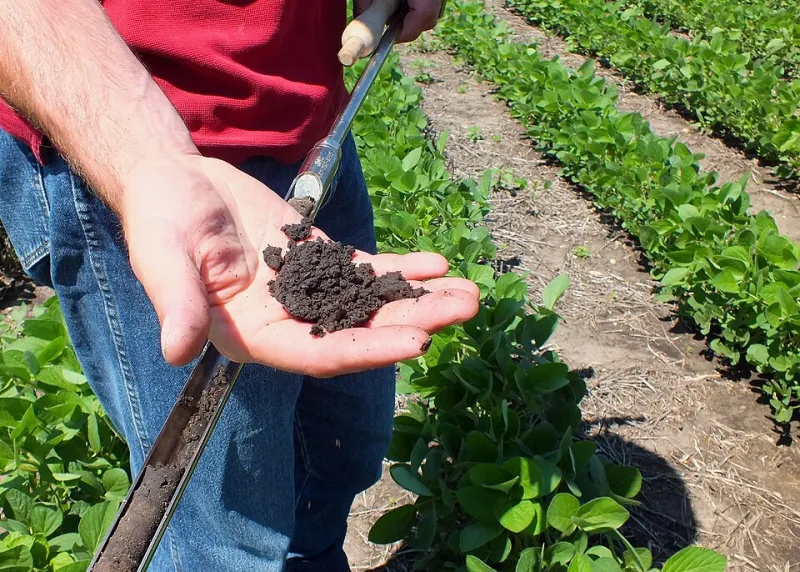
Photo: USDA NRCS South Dakota, Public domain, via Wikimedia Commons
When the Short-Term Signal Overrides the Long-Term Model
Every spring, commodity price ratios send signals that feel actionable. In 2025, the corn-soybean price ratio has tilted favorably toward beans across much of the Corn Belt, and input cost pressures—particularly nitrogen fertilizer—have made corn's cost structure look increasingly burdensome by comparison. The result is a meaningful conversation happening at kitchen tables and ag lender offices alike: should we pull acres out of corn this year?
It is a reasonable question on its face. But reasonable questions deserve rigorous answers, and the financial modeling that underlies most acreage pivot decisions rarely captures the full scope of what a rotation break actually costs. When Martell Crop Projections evaluates acreage shift scenarios for professional clients, the analysis extends well beyond a single-season margin comparison. The findings are consistently instructive—and frequently sobering.
The Yield Drag That Doesn't Show Up in Year One
The agronomic case for corn-soybean rotation is well established, but its financial implications are often treated as background noise rather than a line item in the budget. Continuous soybean production—or even a two-year soybean stretch following a rotation break—introduces a yield penalty that compounds quietly over time.
Research from land-grant universities across Illinois, Iowa, and Indiana consistently documents soybean yield reductions of 5 to 10 percent under continuous or near-continuous production conditions. For a producer running 1,000 acres at average Corn Belt yields, that drag translates to a meaningful bushel loss that must be weighed against any input savings realized by exiting corn. Critically, the yield depression does not fully reverse in the first season corn is reintroduced. Soil structure, organic matter dynamics, and pest pressure—particularly soybean cyst nematode populations—require multiple seasons to rebalance.
In practical terms, a producer who rotates out of corn in 2025 to capture a perceived margin advantage may spend 2026 and 2027 recovering agronomic ground that was never fully priced into the original decision.
Equipment Utilization and the Fixed Cost Trap
Corn production infrastructure is not easily idled. Planters calibrated for corn populations, grain handling systems sized for corn's bulk density, and drying capacity engineered around corn's moisture requirements all represent fixed investments that do not disappear when corn acres shrink. They simply spread their costs across a smaller revenue base.
Consider a central Illinois operation that has invested in a 24-row planter optimized for corn performance. Shifting 30 percent of planted acres to soybeans does not reduce the planter's annual ownership cost by 30 percent. It reduces utilization while the depreciation schedule continues unchanged. The same logic applies to grain bins equipped with high-capacity aeration systems designed for corn drying—assets that sit underemployed when soybean volumes dominate the harvest.
In conversations with Corn Belt producers who executed significant corn-to-soybean shifts in recent years, equipment underutilization consistently emerged as an underappreciated drag on profitability. The fixed cost per bushel rises, the revenue per acre falls, and the margin compression that prompted the rotation change in the first place is often not as dramatic as initial projections suggested.
Basis Behavior in Secondary Crop Markets
Market access is another dimension that deserves careful scrutiny before acreage decisions are finalized. Corn infrastructure—elevators, rail loading facilities, ethanol plants, feed mills—is densely distributed across the primary production regions of the Midwest. That density creates competitive basis environments in most markets, providing producers with meaningful price discovery options at harvest.
Soybean infrastructure, while substantial, is less uniformly distributed in certain geographies. Producers in areas where crush capacity or export logistics are more distant may find that soybean basis behavior is structurally weaker than corn basis in their local market. A producer in western Iowa or eastern Nebraska with strong corn basis access may be trading into a less favorable basis environment when shifting to beans—a cost that only becomes visible when the elevator ticket prints.
This is not a universal dynamic. In regions with robust crush plant access or strong river barge markets, soybean basis can be highly competitive. But the analysis must be conducted at the local level, not the national level. A strong national soybean futures price is not a guarantee of a strong net price at your elevator. Basis compression in secondary markets can quietly erode a significant portion of the margin advantage that prompted the rotation shift in the first place.
A Three-Year Modeling Framework for Rotation Decisions
At Martell Crop Projections, we advocate for a minimum three-year financial model when evaluating acreage rotation changes of meaningful scale. That framework should incorporate the following elements:
Year-one margin comparison — A conventional side-by-side analysis of projected revenue minus projected input costs for corn versus the alternative crop, using current futures prices and realistic local basis assumptions.
Years two and three yield adjustment — A downward revision to soybean yield projections that reflects the agronomic reality of reduced rotation diversity, applied to any acres that will carry soybeans in consecutive years.
Fixed cost reallocation — A recalculation of per-acre fixed costs as corn-specific equipment and infrastructure is spread across a smaller corn base or underutilized in a soybean-heavy system.
Basis sensitivity analysis — A scenario analysis that tests the net price impact of 10- to 20-cent basis compression in the local soybean market relative to the producer's current corn basis environment.
Soil input adjustments — An accounting for any additional inputs—nematicide applications, micronutrient corrections, or cover crop investments—that may be required to manage agronomic risk in a modified rotation.
When producers run this full model rather than a single-season margin comparison, the case for a large-scale corn-to-soybean shift frequently weakens materially. In some scenarios, particularly for operations with significant corn-specific infrastructure and favorable corn basis access, the rotation break represents a net financial loss even when year-one soybean margins appear superior.
Where the Math Does Break Down—and Where It Holds
None of this is to suggest that rotation adjustments are never justified. There are genuine scenarios where the numbers support an acreage shift: operations with flexible equipment capable of efficient soybean production, producers in geographies with strong crush plant basis, and farms where soil health data indicates that a modified rotation may actually improve long-run corn yields by managing specific pest or disease pressures.
The critical distinction is between a decision made on the basis of a rigorous multi-year model and one made on the basis of a single season's price ratio. The former is sound farm financial management. The latter is reactive acreage allocation that frequently costs more than it saves.
The Corn Belt case studies that inform Martell's rotation analysis reveal a consistent pattern: producers who maintained disciplined corn-soybean rotations through price ratio volatility consistently outperformed peers who made large acreage pivots when the ratio moved against corn—not because corn was always the superior crop in a given year, but because the total system economics of a balanced rotation proved more durable than the short-term margin signal suggested.
The Discipline of the Long View
In 2025, the pressure to respond to market signals with immediate acreage action is real. Input costs are elevated, corn margins are compressed, and soybean prices are sending a clear short-term message. But the most financially durable agricultural operations are those that treat acreage allocation as a strategic decision rather than a tactical one—weighing the full multi-year cost structure before committing to a rotation change that may take several seasons to fully reveal its consequences.
The rotation penalty is real, and it is frequently larger than the margin calculation that prompted the pivot. Running the complete model before the first seed order is placed is not conservatism—it is precision.