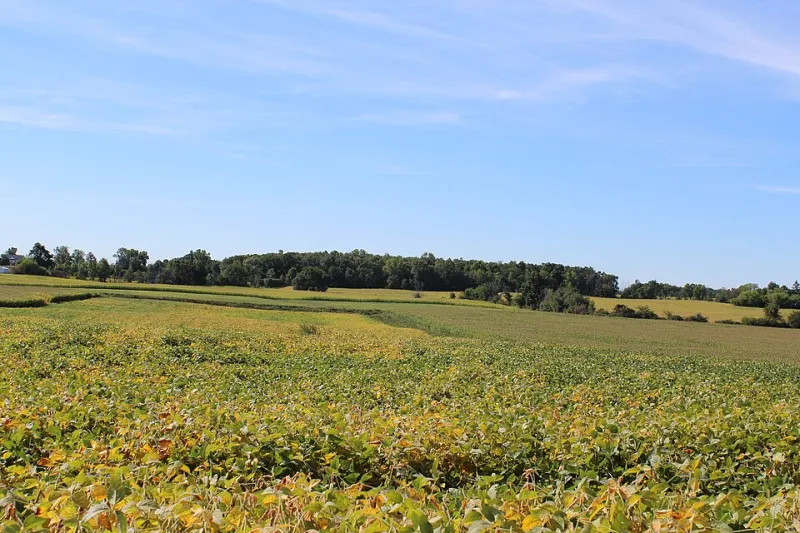
What Lives in Your Soil Is Predicting Your Yield Before You Plant a Single Seed
Photo: International Union of Pure and Applied Chemistry (IUPAC), CC BY-SA 4.0, via Wikimedia Commons
Every spring, millions of American farmers review soil test results and make planting decisions based on pH, phosphorus, potassium, and organic matter percentages. These are legitimate, time-tested data points. But they represent a fundamentally incomplete picture of what a field is capable of producing—because they measure chemistry while ignoring biology entirely.
Beneath every acre of productive farmland exists a living ecosystem of extraordinary complexity. Bacterial populations numbering in the billions per gram of soil, fungal networks threading through root zones, protozoa cycling nitrogen, and nematodes regulating microbial populations—this biological infrastructure is not incidental to crop performance. It is, in many cases, the primary driver of it. And for the most part, it goes completely unmeasured on American farms.
That is beginning to change. Soil microbial analysis—once confined to university research programs and specialty organic operations—is now accessible to commercial row-crop producers at price points that make field-scale testing economically defensible. More importantly, the data it generates is proving useful not just for soil health enthusiasts, but for yield forecasters trying to understand why two fields with nearly identical chemistry panels produce materially different results.
The Gap Between Chemistry and Performance
Consider a scenario familiar to many Corn Belt agronomists: two fields, side by side, same hybrid, same fertility program, same planting date. One consistently yields 15 to 20 bushels per acre above the other. Standard soil tests show no meaningful difference. Drainage maps look similar. Yet the yield gap persists, year after year.
In many such cases, the explanation lives in the microbial layer. Soils with degraded bacterial diversity show reduced nitrogen mineralization rates, meaning applied fertilizer is not cycling efficiently into plant-available forms. Fields with suppressed mycorrhizal fungal populations—common in heavily tilled, high-input systems—lose a critical mechanism for phosphorus uptake, leaving nutrients in the soil profile that the plant cannot effectively access regardless of application rates.
Soil biology testing quantifies these dynamics. A comprehensive microbial panel typically measures total bacterial biomass, fungal-to-bacterial ratios, active carbon levels, and in more advanced versions, specific functional groups such as nitrogen-fixing bacteria or phosphorus-solubilizing organisms. When mapped against yield history, these measurements often explain performance variation that chemistry alone cannot.
Interpreting Microbial Data for Yield Forecasting
The practical challenge for producers and agronomists is translating microbial data into actionable forecasts. Unlike a low phosphorus reading—which carries a well-established response curve—microbial results require a different interpretive framework.
Several indicators have emerged as particularly reliable signals for yield potential assessment.
Active carbon, sometimes called permanganate oxidizable carbon, measures the fraction of soil organic matter that is biologically available in the short term. It functions as a proxy for overall microbial activity and soil energy. Fields with active carbon levels below roughly 400 parts per million frequently show muted response to nitrogen applications—not because nitrogen is absent, but because the biological machinery to cycle it efficiently is compromised.
Fungal-to-bacterial ratios provide insight into the stability and maturity of the soil food web. A ratio skewed heavily toward bacteria—common in conventionally tilled, continuous corn systems—often correlates with lower nutrient use efficiency and reduced drought resilience. Fields trending toward more balanced or fungal-dominant ratios, by contrast, tend to show greater yield consistency across variable weather years, which matters considerably for forward projections.
Microbial biomass carbon represents the total mass of living microorganisms in the soil and serves as a broad indicator of biological capacity. Significant differences in biomass carbon between fields—even those with comparable organic matter percentages—can explain divergent responses to the same management inputs.
For yield forecasting purposes, the most valuable application of this data is comparative: not measuring a field against an abstract ideal, but benchmarking it against your own operation's highest-performing acres. Identifying which fields have the biological infrastructure to convert inputs into yield—and which do not—is genuinely predictive information.
Competitive Intelligence in Plain Sight
There is a straightforward reason why soil microbial analysis functions as competitive intelligence: almost no one is doing it. Adoption rates among commercial row-crop producers remain low, and the information asymmetry that creates is meaningful.
A producer who understands the biological profile of each field can make better decisions about where to concentrate inputs, which acres are positioned to respond to cover crop programs, and which fields are likely to underperform even in favorable weather years. This is not speculative—it is the application of a more complete data set to decisions that have always required some form of yield forecasting.
At the operational level, this translates to resource allocation advantages. Directing premium hybrid placement, enhanced fertility investment, or precision irrigation toward fields with strong biological profiles—rather than distributing resources uniformly—can materially shift whole-farm profitability without increasing total input spending.
Practical Steps for Getting Started
For producers considering soil biology testing for the first time, a few practical considerations help ensure the data is useful rather than merely interesting.
Sampling timing matters significantly. Microbial populations fluctuate with soil temperature and moisture, so samples collected under comparable conditions—ideally at similar points in the seasonal cycle—produce more meaningful comparisons. Early spring before tillage, or fall after harvest, are generally preferred windows for baseline establishment.
Field selection for initial testing should prioritize the performance outliers in your operation: your consistently highest-yielding fields and your persistent underperformers. The contrast between these profiles is where the interpretive value is greatest and where management hypotheses are most likely to be testable.
Laboratory selection warrants attention as well. The soil biology testing space includes providers with meaningfully different methodologies and reporting formats. Panels that include active carbon, microbial biomass carbon, and fungal indicators alongside standard chemistry allow for integrated analysis rather than treating biological data in isolation.
Finally, a single year of data has limited forecasting value. Building a two- to three-year baseline, correlated against actual yield outcomes, is what converts microbial readings from curiosity into reliable predictive input.
A More Complete Picture of Field Potential
Precision agriculture has invested heavily in surface-level data: yield monitors, satellite imagery, variable-rate application technology. These tools have genuine value. But they measure outputs and manage inputs—they do not explain the underlying biological capacity that determines how efficiently those inputs are converted into yield.
Soil microbial analysis addresses that gap. It is not a replacement for conventional soil testing, sound agronomy, or market-informed planting decisions. It is an additional layer of field intelligence that, for producers who integrate it into a systematic forecasting framework, routinely reveals yield potential—and yield risk—that no other measurement captures.
The farms that understand their soil biology today are developing a forecasting advantage that will compound over time. The question is not whether this information is useful. The question is how long you can afford to leave it unmeasured.