When Last Year Becomes a Liability: Breaking the Single-Season Data Trap in Crop Forecasting

Photo: farmer reviewing multi-year crop data charts on tablet in field, via as2.ftcdn.net
There is a well-documented tendency in professional forecasting — across disciplines — to assign disproportionate weight to the most recent data point. In agricultural planning, this tendency is not merely an intellectual shortcoming. It carries measurable financial consequences. When farmers, agronomists, and commodity analysts construct projections by leaning heavily on a single prior season's outcomes, they are not forecasting the future. They are, in effect, narrating the past and calling it a plan.
At Martell Crop Projections, the term we use internally for this dynamic is single-season anchoring. It is pervasive, understandable, and — in most years — expensive.
Why the Most Recent Season Feels Like Ground Truth
The appeal of recent data is intuitive. Last year's yields came from your fields. Last year's input costs appeared on your invoices. Last year's weather patterns played out across your specific geography. No dataset feels more relevant than the one you just lived through.
But relevance and representativeness are not the same thing. A season that produced exceptional corn yields across the western Corn Belt due to a narrow window of favorable precipitation in late July does not establish a new yield floor. A season in which anhydrous ammonia prices spiked to historically anomalous levels does not define the permanent cost structure for nitrogen management. Yet both of these outcomes, when treated as baseline assumptions for the following year, quietly distort the projections built on top of them.
The forecasting literature describes this as overfitting — constructing a model so precisely calibrated to one dataset that it loses predictive power when conditions change. In quantitative modeling, overfitting is a technical error. In agricultural decision-making, it is a human one. And human errors tend to be harder to detect.
The Three Domains Where Single-Season Bias Causes the Most Damage
Soil Condition Assumptions
Soil does not reset at the end of a calendar year. Compaction events, organic matter trajectories, pH drift, and drainage capacity evolve across multi-year cycles. A season in which high-yield outcomes masked underlying soil degradation can create false confidence in field productivity. If a producer then enters the following season assuming the same yield potential without accounting for the cumulative soil stress that may have been masked by favorable weather, the projection carries structural error from the outset.
Robust forecasting requires that soil condition data be evaluated across a minimum of three to five seasons, with explicit attention to directional trends rather than point-in-time snapshots.
Input Cost Modeling
Fertilizer markets, chemical markets, and seed pricing are all subject to supply chain disruptions, geopolitical shifts, and demand-side volatility that can make any single year's pricing deeply unrepresentative of the forward cost environment. The 2021–2022 nitrogen price cycle is perhaps the clearest recent example. Producers who built 2023 cost models heavily weighted toward 2022 input prices were carrying significant forecast error before they planted a single acre.
A more defensible approach weights input cost assumptions across a rolling multi-year average, adjusted for known structural changes in supply chains or production capacity — not anchored to the most recent invoice.
Climate Pattern Extrapolation
This is arguably the most consequential domain, and the one in which single-season anchoring causes the most visible damage. Climate volatility across the major US production regions has increased measurably over the past two decades. A single season's precipitation distribution, growing degree day accumulation, or frost timing is an increasingly unreliable guide to the following season's conditions.
Producers who entered the 2023 growing season expecting a repeat of 2022's late-season moisture across parts of the Northern Plains discovered this at significant cost. The assumption that last year's climate pattern represented a new normal was not supported by the historical record — it was simply the most recent data point, dressed up as a forecast.
Building a Multi-Year Weighting Framework
The alternative to single-season anchoring is not complexity for its own sake. It is disciplined data architecture — a structured approach to weighting historical inputs so that the resulting projections reflect systemic patterns rather than recent noise.
The following framework represents the approach used in Martell's internal forecasting models:
Establish a five-year base window. For most agronomic and market variables, five years of historical data provides sufficient range to capture meaningful variability without over-indexing on distant conditions that may no longer apply to current production systems.
Apply recency weighting with a ceiling. More recent seasons should carry somewhat greater weight than older ones — but that weight should be capped. In our models, the most recent season typically accounts for no more than 30 percent of the weighted average for any given variable. This preserves the informational value of recent experience without allowing it to dominate the projection.
Flag structural breaks explicitly. When a variable has undergone a genuine structural change — a new seed trait platform, a permanent shift in regional drainage infrastructure, a lasting change in export demand — that break point should be identified and the pre-break data discounted accordingly. Not all historical data is equally applicable.
Separate signal from noise at the field level. County-level or regional averages can obscure field-specific variation that matters enormously for localized projections. Multi-year field records, when available, should anchor the agronomic layer of any forecast, with regional data used to calibrate rather than override.
What This Looks Like in Practice
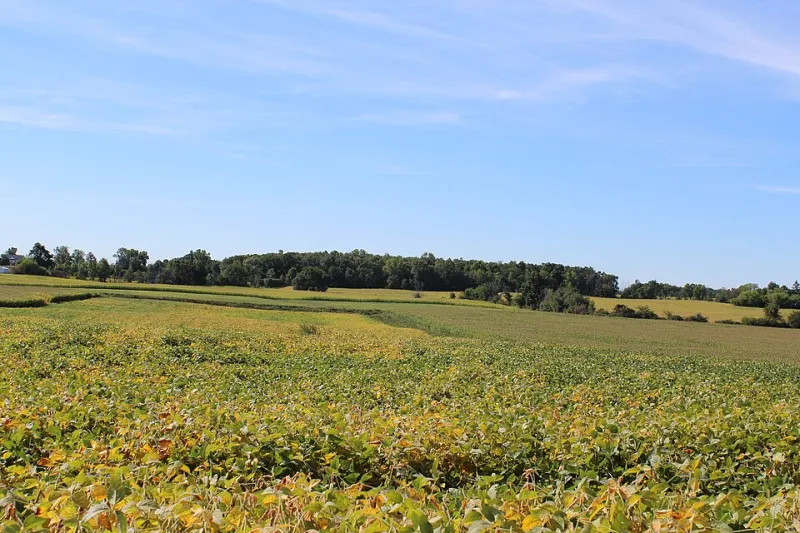
Consider a soybean producer in central Illinois building yield projections for the 2025 season. A single-season anchor to 2024 might produce a baseline yield estimate that reflects last year's favorable July conditions — conditions that agronomists and climate forecasters are not projecting for 2025.
A multi-year weighted model, by contrast, would incorporate the full distribution of yield outcomes across the prior five seasons, flag the 2024 result as an outlier in the upper quartile, and produce a projection that more accurately reflects the probability-weighted range of outcomes. The resulting forecast would likely carry a lower central estimate and a wider confidence interval — which is not a weakness. It is an accurate representation of forward uncertainty.
That accuracy, in turn, enables better decisions about crop insurance coverage levels, forward contracting volume, and input investment thresholds.
The Competitive Cost of Overconfidence
In markets where margin compression is structural and operational precision is a genuine differentiator, forecast quality is not a secondary concern. A projection built on a single season's data does not merely carry analytical error — it carries financial exposure. Overconfident yield estimates lead to under-hedged positions. Underestimated input costs compress margins that were already thin. Misread climate signals result in planting and management decisions that optimize for last year's conditions rather than this year's.
The producers and analysts who consistently outperform their peers are not necessarily those with access to better data. They are those who use the data they have more rigorously — weighting it appropriately, acknowledging its limitations, and resisting the very human tendency to treat recent experience as settled truth.
Last year was informative. It was not a forecast.